
Summer Games: Previous | Next
Return to main page / index of medals.
Return to Eric Holcomb Company home page.
1972 SUMMER OLYMPIAD
MUNICH, GERMANY
DESCRIPTION
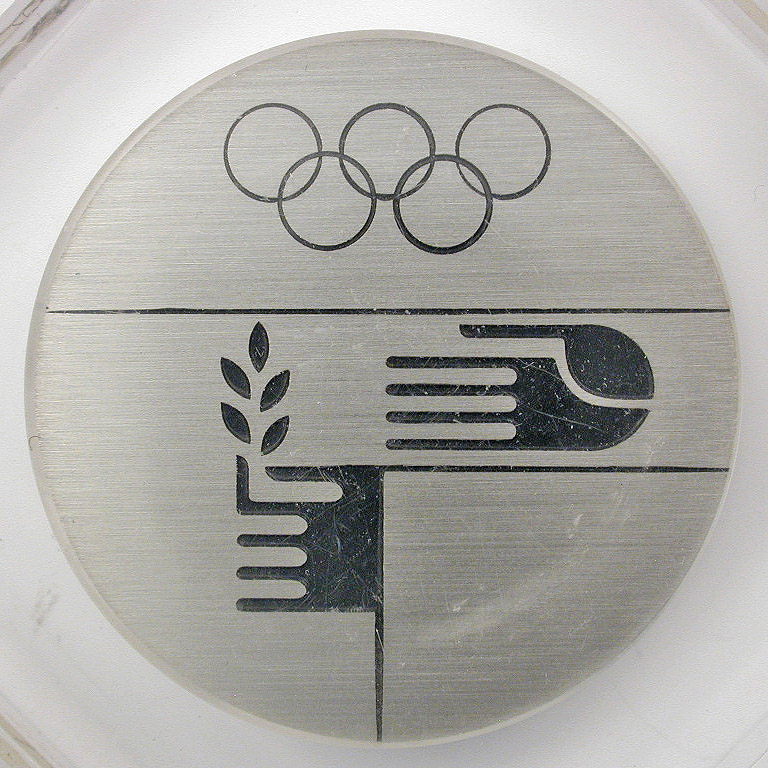
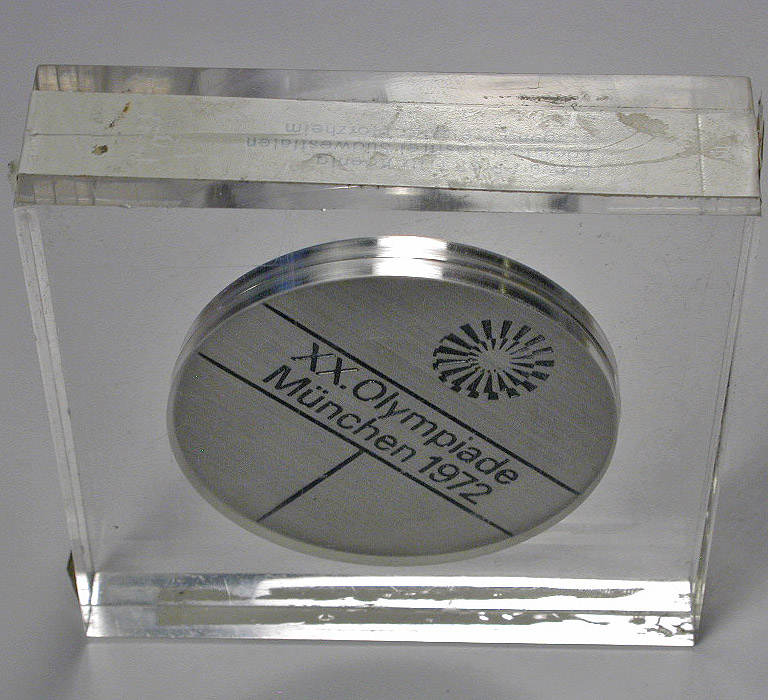
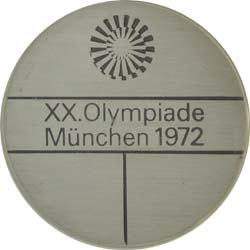
A rather unremarkable OPM, this issue's obverse depicts an emblem of a wreath of rays in a spiraling display over the legend XX.Olmpiade Munchen 1972. The reverse is a bit more stylistic with the Olympic rings over two hands, one of which holds the symbol of an olive branch. Most medals are encapsulated in a clear, lucite case.
THE GAMES
Although these Games will be forever scared by the terrorist attack which resulted in the death 12 Israeli athletes, it also served as the venue for some of the most memorable feats in olympic history. Russia's Olga Korbut's perfect Gymnastic performances vaulted her into a "media darling," and American Mark Spitz swam his way to an Olympic record of seven gold medals. The 1972 Munich Games were the largest yet, setting records in all categories, with 195 events and 7,173 athletes from 121 nations. They were supposed to celebrate peace and for the first ten days, all went well. But in the early morning of 5 September, eight Palestinian terrorists broke into the Olympic Village, killed two members of the Israeli team and took nine more hostage. In an ensuing battle, all nine Israeli hostages were killed, as were five of the terrorists and one policeman. The Olympics were suspended and a memorial service was held in the main stadium. In defiance of the terrorists, the International Olympic Committee ordered the competitions to resume after a pause of 34 hours. All other details about the Munich Games paled in significance, but it did have its highlights. Archery was reintroduced to the Olympic program after a 52-year absence and handball after a 36-year absence. Whitewater canoeing was included for the first time. The 1972 Games were also the first to have a named mascot: Waldi the dachshund. Lasse Viren of Finland fell midway through the 10,000m final, but rose and set a world record to win the first of his four career gold medals. Freestyle wrestler Ivan Yarygin of Russia pinned all seven of his opponents en route to his first Olympic championship in the heavyweight division. West German, Liselott Linsenhoff, competing in the dressage event, became the first female equestrian to win a gold medal in an individual event.
Additional Photos