
Summer Games: Previous | Next
Return to main page / index of medals.
Return to Eric Holcomb Company home page.
1968 SUMMER OLYMPIAD
MEXICO CITY, MEXICO
DESCRIPTION
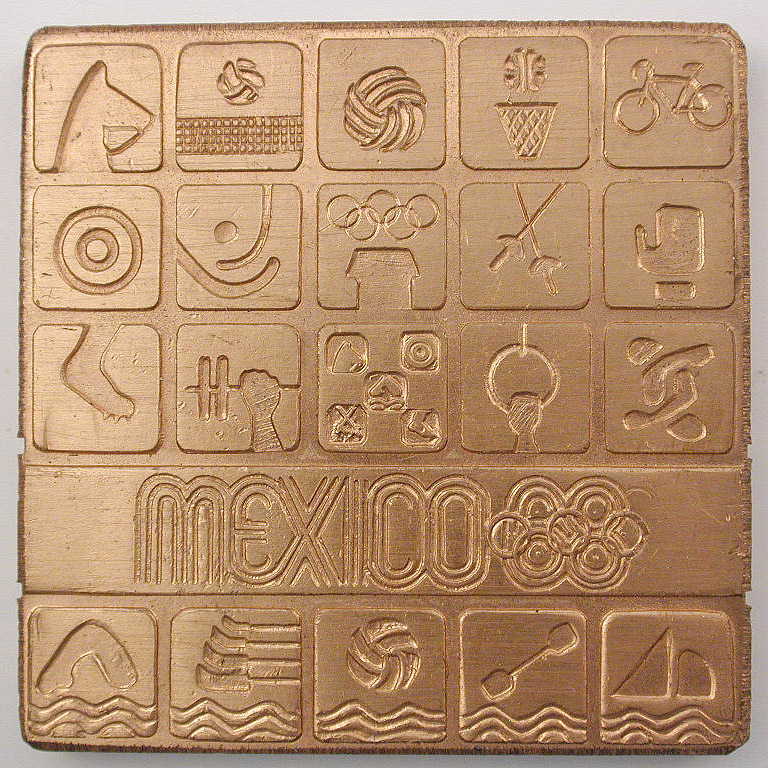
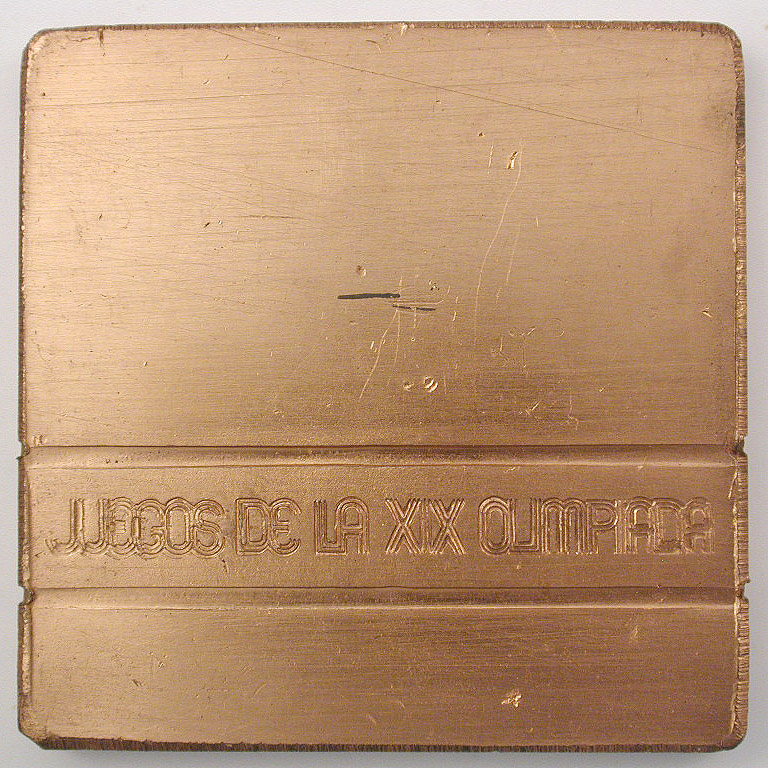
This OPM would mark a clear departure from the traditional, round OPM. The obverse displays a series of pictograms separated by the Mexico Olympic emblem. The reverse remains completely bare except for the legend JUEGOS DE LA OLIMPIADA. The medals were presented in either a hinged wooden case (very rare) or a plastic wrapper.
THE GAMES
The choice of Mexico City to host the 1968 Olympics was a controversial one because of the city's high altitude, 2300m, which meant that the air contained 30% less oxygen than at sea level. Sure enough, the rarefied air proved disastrous to many athletes competing in endurance events. On the other hand, the high altitude led to world records in all of the men's races that were 400m or shorter, including both relays, and in the long jump and triple jump as well. Bob Beamon's spectacular long jump of 8.90m would last as a world record for 22 years. The Mexico City Olympics, the first Summer Games to include sex testing for women, were blessed with many outstanding heroines. Mexican hurdler Enriqueta Basilio became the first woman to light the cauldron at the Opening Ceremony. Eulalia Rolinska of Poland and Gladys de Seminario of Peru were the first women to compete in shooting. Wyomia Tyus of the United States became the first repeat winner of the 100m dash. The most popular female athlete of the 1968 Games was Vera Caslavska, the Czech gymnast. After the Soviet invasion of Czechoslovakia two months before the Olympics, Caslavska went into hiding for three weeks. She emerged to win four gold medals and two silvers. On the male side, Al Oerter of the United States won the discus throw for the fourth time. The 1968 Games also saw the first drug disqualification, as a Swedish entrant in the modern pentathlon, Hans-Gunnar Liljenwall, tested positive ... for excessive alcohol.
Additional Photos