
Summer Games: Previous | Next
Return to main page / index of medals.
Return to Eric Holcomb Company home page.
1956 SUMMER OLYMPIAD
MELBOURNE, AUSTRALIA
DESCRIPTION
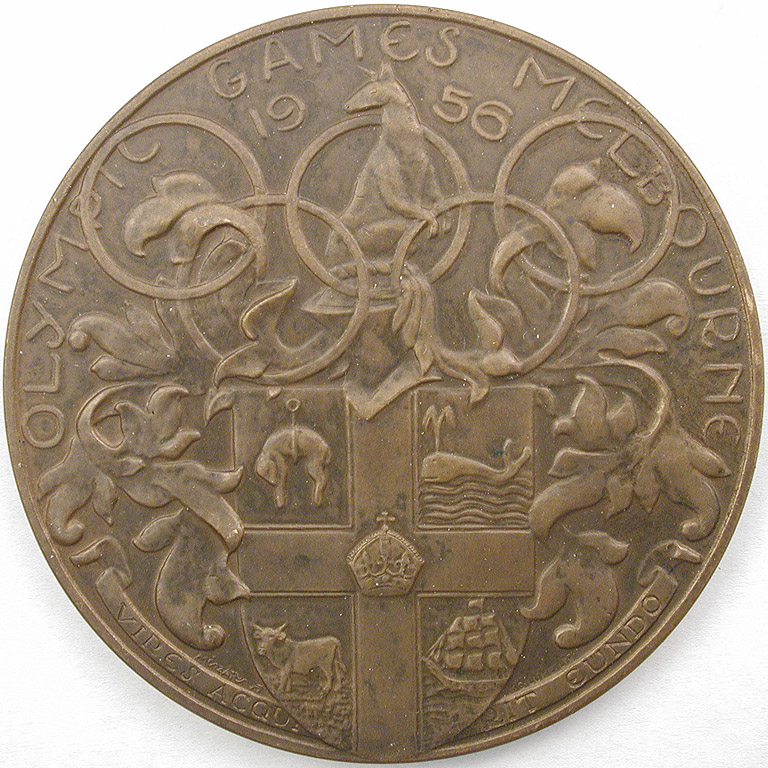
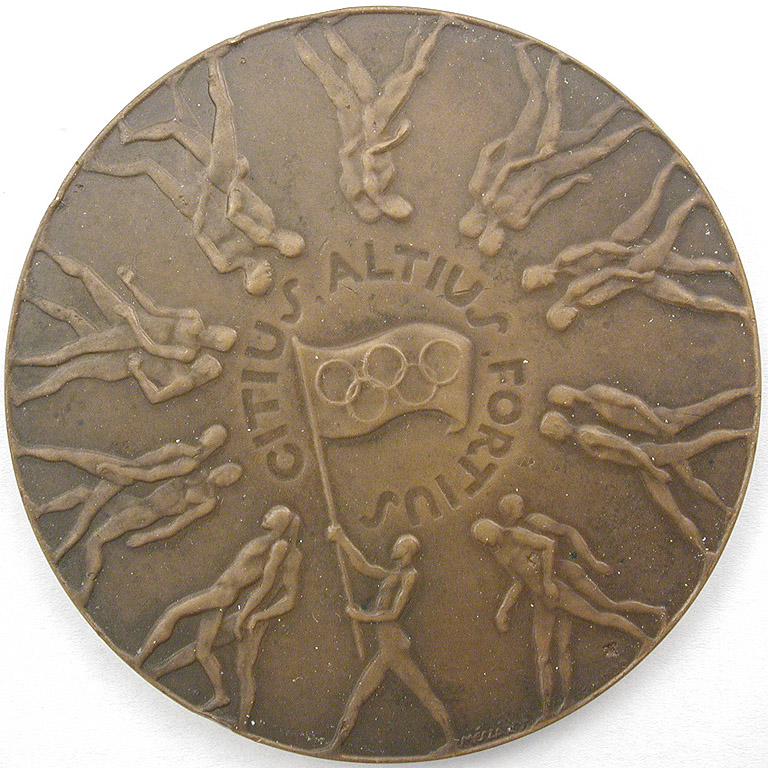
The Olympic motto CTIUS ALTIUS FORTIUS lies within a circle of athletes marching in pairs behind a flag bearer. The designer's name and the date 1955 appears along the lower right rim. The reverse displays more Olympic athletes in a busy motif which also includes the Melbourne Coat of Arms and the Olympic rings. The legend OLYMPIC GAMES MELBOURNE 1956 is inscribed along its periphery. The medals were presented in a clear plastic case.
THE GAMES
Melbourne won the right to host the 1956 Olympics by one vote over Buenos Aires. Australian quarantine laws were too severe to allow the entry of foreign horses, so the equestrian events were held separately in Stockholm. The Melbourne Games were the first to be held in the southern hemisphere. Laszlo Papp of Hungary became the first boxer to win three gold medals. American Pat McCormick won both diving events, just as she had in 1952. Two athletes dominated the gymnastics competition. On the men's side, Ukrainian Viktor Chukarin earned five medals, including three gold, to bring his career total to eleven medals, seven of them gold. Agnes Keleti of Hungary brought her career total to ten medals by winning four gold medals and two silver. The U.S. basketball team, led by Bill Russell and K.C. Jones, put on the most dominant performance in Olympic history, scoring more than twice as much as their opponents and winning each of their games by at least 30 points. U.S. weightlifter Paul Anderson weighed 137.9kg. In weightlifting, ties are broken by awarding the higher place to the athlete with the lower body weight. Incredibly, this worked to Anderson's advantage when he tied for first with Humberto Selvetti of Argentina. Selvetti weighed 143.5kg. Prior to 1956, the athletes in the Closing Ceremony marched by nation, as they did in the Opening Ceremony. In Melbourne, following a suggestion by a young Australian named John Ian Wang, the athletes entered the stadium together, as a symbol of global unity.
Additional Photos