
Summer Games: Previous | Next
Return to main page / index of medals.
Return to Eric Holcomb Company home page.
1948 SUMMER OLYMPIAD
LONDON, ENGLAND
DESCRIPTION
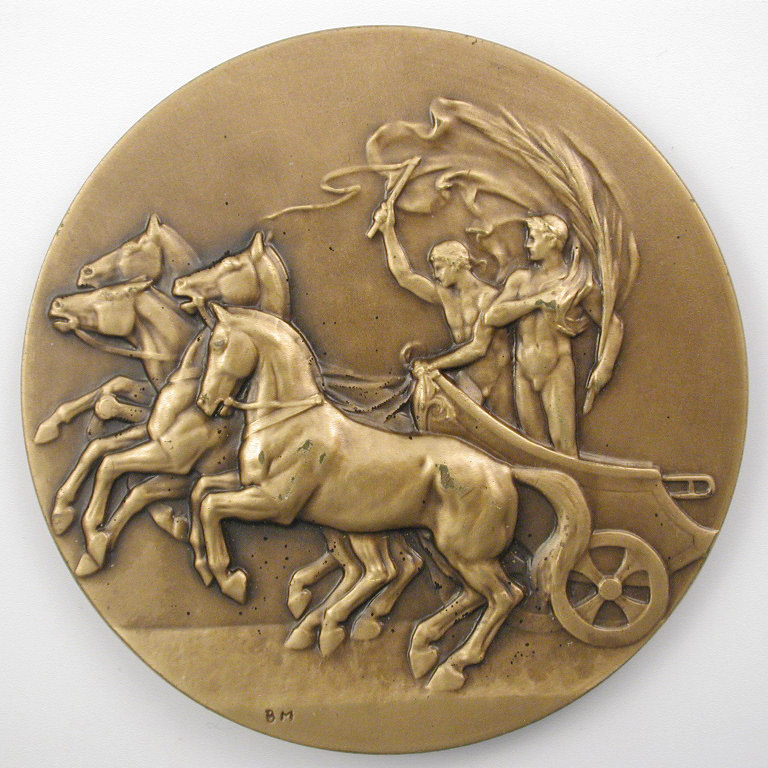
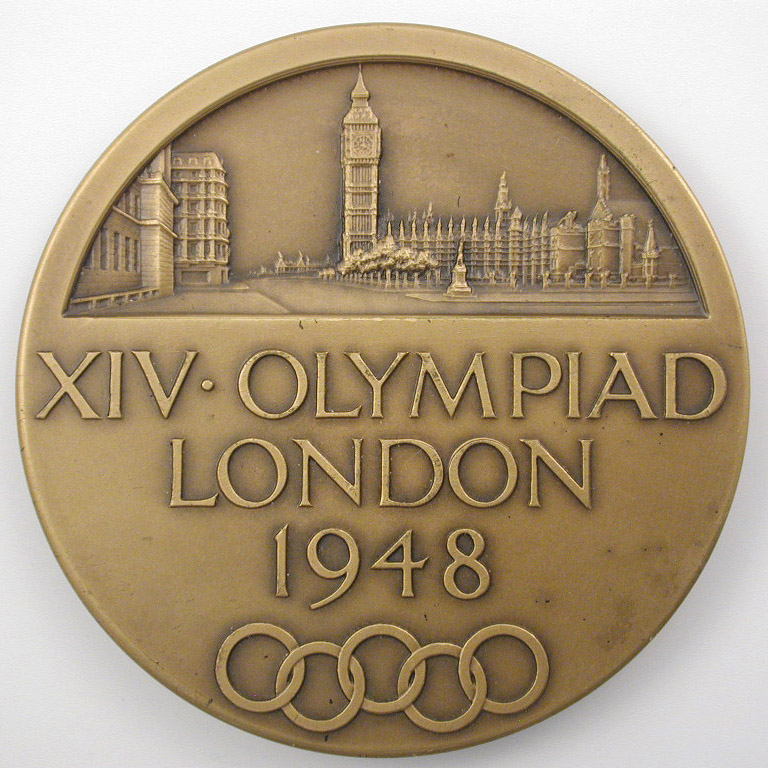
The obverse is essentially the same design as that used on the 1908 London & 1912 Stockholm Medals. Four horses (in motion) drawing a chariot (and driver) and a standing judge holding the "palm of victory." The reverse was obviously modeled on the 1924 Paris OPM and displays a city view of London (Big Ben, etc.) over the legend XIV OLYMPIADE / LONDON / 1948 and the Olympic rings. The medals were presented in a green cardboard box with the name of the medal-maker stamped on the inside.
THE GAMES
The 1948 London Games were the first to be shown on home television, although very few people in Great Britain actually owned sets. A women's canoeing event was held for the first time - and won by Karen Hoff of Denmark. 17-year-old American Bob Mathias won the decathlon only four months after taking up the sport. He is the youngest athlete in Olympic history to win a men's athletics event. Two athletes who were Olympic champions in 1936 managed to defend their titles twelve years later. They were Ilona Elek of Hungary in women's foil fencing and Jan Brzak of Czechoslovakia in the canoeing Canadian pairs 1000m. Fanny Blankers-Koen of the Netherlands was the world record holder in six events, but, according to the rules of the day, was only allowed to enter four. She won all four: the 100m dash, the 80m hurdles, the 200m and the 4x100m relay. Concert pianist Micheline Ostermeyer of France won both the shot put and the discus throw. Karoly Takacs was a member of the Hungarian world champion pistol shooting team in 1938 when a grenade shattered his right hand - his pistol hand. Takacs taught himself to shoot with his left hand and, ten years later, he won an Olympic gold medal in the rapid-fire pistol event.
Additional Photos