

Summer Games: Previous | Next
Return to main page / index of medals.
Return to Eric Holcomb Company home page.
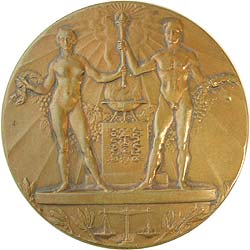
1928 SUMMER OLYMPIAD
AMSTERDAM, HOLLAND (Netherlands)
DESCRIPTION
The obverse depicts a male and female athletic figures (nude) standing on a podium holding a torch over the Olympic flame. The reverse design has Nike over Marathon tower with a shield of Amsterdam between two hemispheres. Olympic stadium in background and the inscription IX OLYMPIADE AMSTERDAM 1928 lies along the periphery. The medal was presented in a white cardboard box with gold edges and an inscription printed in a closed circle.
THE GAMES
The Amsterdam Olympics of 1928 were held in an atmosphere of peace and harmony that preceded twenty years of economic uncertainty and war. Perhaps the Games were best exemplified by the experience of Australian rower Henry Pearce. Midway through his quarterfinal race, he stopped rowing to allow a family of ducks to pass single file in front of his boat. Pearce won the race anyway and later, the gold medal as well. At the Opening Ceremony, the team from Greece led the Parade of Nations and the host Dutch team marched in last. Greece first, hosts last would become a permanent part of the Olympic protocol. Athletes from 28 different nations won gold medals in Amsterdam, a record that would last for 40 years. The number of female athletes more than doubled as women were finally allowed to compete in gymnastics and athletics. For the first time, Asian athletes won gold medals. Mikio Oda of Japan won the triple jump, while his teammate, Yoshiyuki Tsuruta, won the 200m breaststroke. Meanwhile, the team from India swept to victory in field hockey. Between 1928 and 1960, Indian teams won six straight gold medals. Another winning streak began in 1928. Hungary earned the first of seven consecutive gold medals in team sabre fencing.
Additional Photos

