
Summer Games: Previous | Next
Return to main page / index of medals.
Return to Eric Holcomb Company home page.
1924 SUMMER OLYMPIAD
PARIS, FRANCE
DESCRIPTION
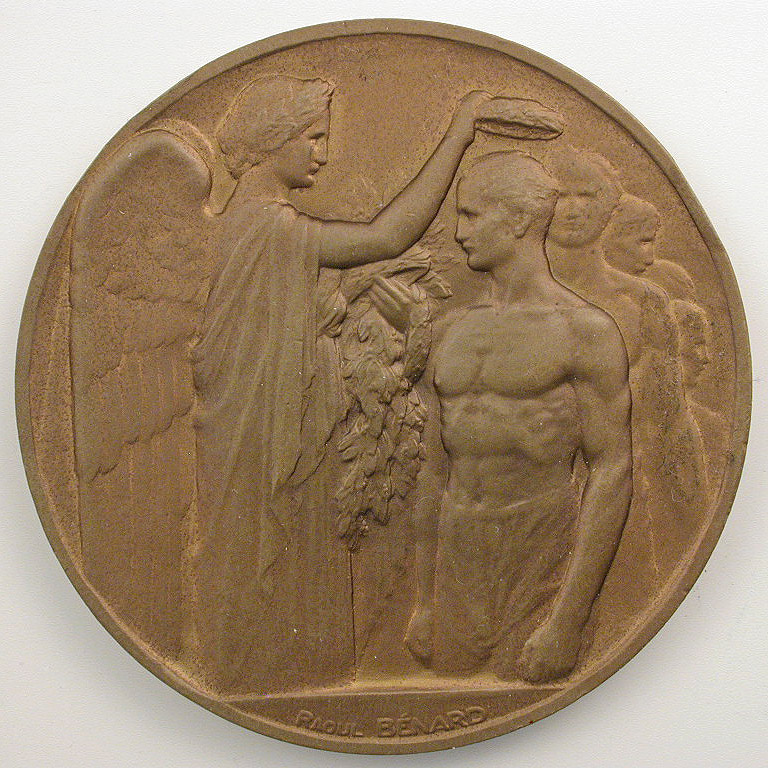
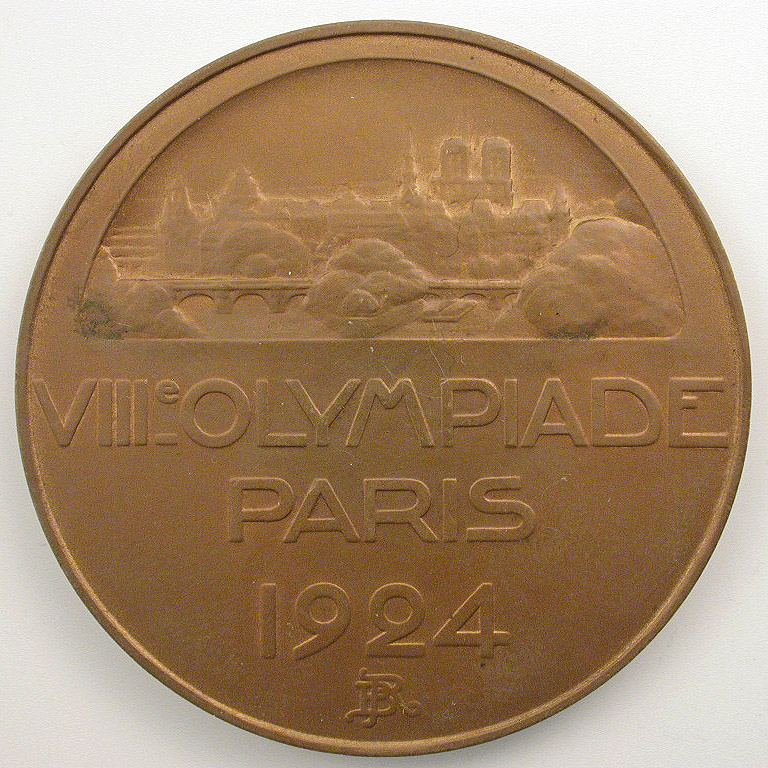
A scene of the goddess Nike crowning victorious athletes with laurel wreaths and the designer's name is depicted on the obverse while the reverse offers a view of the Paris skyline over the legend VIII OLYMPIADE / PARIS / 1924. The medal was presented in a brown box with red interior.
THE GAMES
At the 1924 Paris Games, the Olympic motto, "Citius, Altius, Fortius," (Swifter, Higher, Stronger) was introduced, as was the Closing Ceremony ritual of raising three flags: the flag of the International Olympic Committee, the flag of the host nation and the flag of the next host nation. The number of participating nations jumped from 29 to 44, signaling widespread acceptance of the Olympics as a major event, as did the presence of 1000 journalists. Women's fencing made its debut as Ellen Osiier of Denmark earned the gold medal without losing a single bout. In a single day, Johnny Weissmuller of the United States won two gold medals in swimming and a bronze medal in water polo. He later went to Hollywood and starred as Tarzan in twelve movies. American swimmer Gertrude Ederle won a bronze medal in the 100m freestyle but her claim to fame would come two years later by becoming the first woman to swim across the English Channel, and in a time almost two hours faster than any man had ever achieved. Finnish runner Paavo Nurmi, won five gold medals to add to the three he had won in 1920. His most spectacular performance occurred on July 10th. First, he easily won the 1 500m. Then, a mere 55 minutes later, he returned to the track and won the 5000m. Nurmi's teammate, Ville Ritola, did not do badly either in 1924, winning four gold medals and two silver.
Additional Photos