
Summer Games: Previous | Next
Return to main page / index of medals.
Return to Eric Holcomb Company home page.
1912 SUMMER OLYMPIAD
STOCKHOLM, SWEDEN
& Erik Lindberg
DESCRIPTION
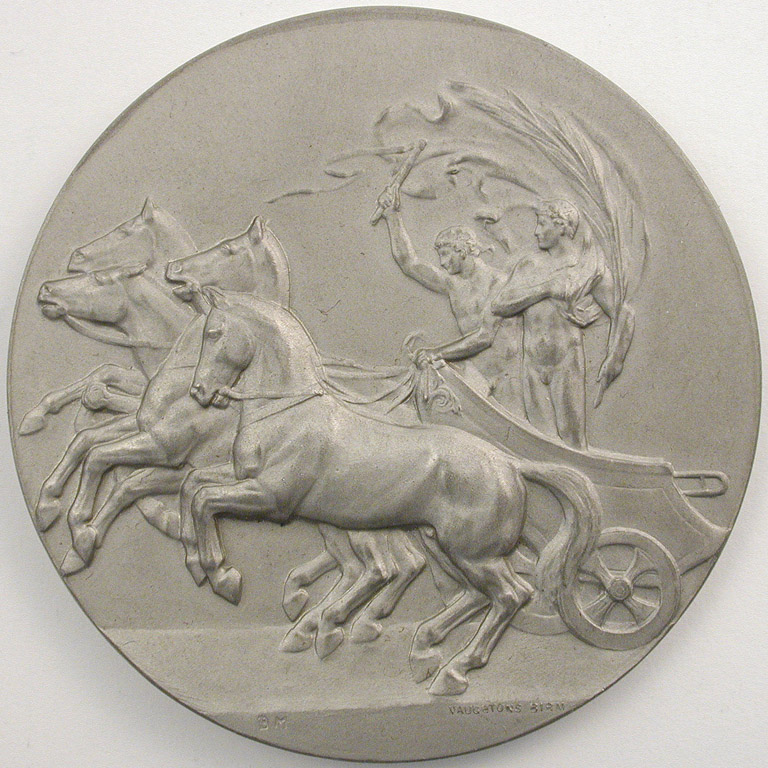
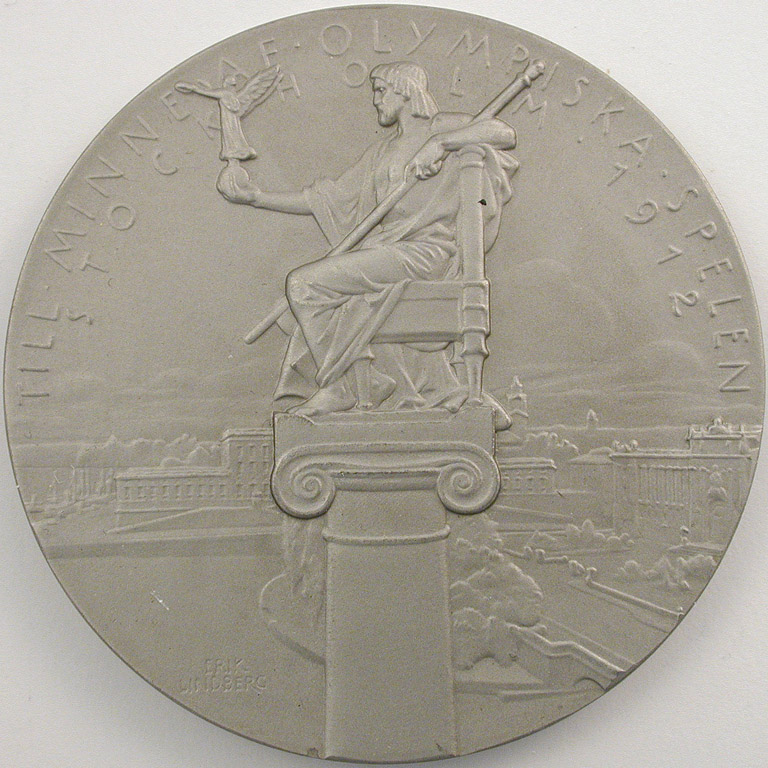
The same obverse design as that used on the 1908 London OPM, with four horses (in motion) drawing a chariot (and driver) and a standing judge holding the "palm of victory" was used for the Stockholm issue as well. The unique reverse boasts an intricate depiction of Zeus sitting atop an ionic column and holding a miniature figure of Nike. An outline of the city of Stockholm (including the Royal Palace, Helgeansholmen Island and Riksdag House) lies in the background.
THE GAMES
Held in Stockholm, the 1912 Olympics were a model of efficiency. The Swedish hosts introduced the use of unofficial electronic timing devices for the track events, as well as the first use of a public address system. The modern pentathlon was added to the Olympic program. Women's events in swimming and diving were also introduced. Sweden would not allow boxing contests to be held in their country which led the International Olympic Committee to limit the power of host nations in deciding the Olympic program. If there was an unofficial theme of the 1912 Games, it was endurance. The course for the cycling road race was 320km (199 miles), the longest race of any kind in Olympic history. In Greco-Roman wrestling, the middleweight semifinal match between Estonian Martin Klein and Finland's Alfred Asikainen lasted eleven hours. Hannes Kohlemainen of Finland won three gold medals in long-distance running. The most popular hero of the 1912 Games was Jim Thorpe of the United States. Thorpe won the five-event pentathlon and shattered the world record in the ten-event decathlon. One member of the Austrian team that finished second in the team fencing event was Otto Herschmann, who was, at that time, president of the Austrian Olympic Committee. Herschmann is the only sitting national Olympic committee president to win an Olympic medal.
Additional Photos